
Single Tooth Implant in Riverside, CA
One missing tooth is a small problem that gets bigger the longer it sits. This is the page for patients who want it replaced once, replaced well, and planned by the dentist other dentists in Riverside refer their harder cases to.
Why One Missing Tooth Is Worth Replacing Properly
If a tooth has been pulled, cracked past saving, or lost to an old root canal that failed, you have a decision in front of you: replace it, or leave the gap. A single tooth implant in Riverside, CA is the option that replaces the root as well as the crown, which is the part most patients do not realize matters. The other options replace what you can see. Only the implant replaces what is under the gum.
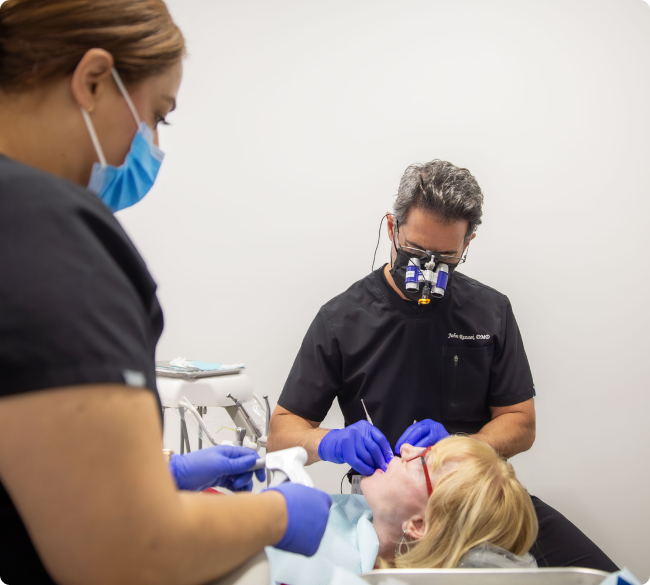
Vivid Dental sits on Arlington Avenue and is led by Dr. John Rezaei, a board-certified prosthodontist certified by the American Board of Prosthodontics. He completed a three-year prosthodontics residency after dental school and a two-year fellowship in implant surgery on top of that, and he is a Fellow of the American College of Prosthodontists. He both places the implant and designs the final crown, so the case is not split between two offices that never talk to each other.
That is why general dentists around Riverside and the Inland Empire send their implant cases here. The plan is drawn from a 3D scan of your jaw, the options are shown to you on the screen, and the smallest intervention that actually solves the problem is the one we recommend first.
What Is a Single Tooth Implant, in Plain Terms?
A single tooth implant has three parts. The implant itself is a small titanium post, roughly the size of the natural root it is replacing, that sits inside the jawbone. The abutment is a connector that screws into the top of the post and sits at or just above the gumline. The crown is the visible tooth, usually zirconia or porcelain fused to zirconia, that attaches to the abutment. Together they behave like one tooth. You brush it and floss around it like the ones beside it.
Titanium is used for the post because bone grows directly onto it, a process called osseointegration. Over roughly three to six months, the outer layer of your jawbone remodels around the threads of the implant and locks it in place. That is what makes the finished tooth stable enough to chew almond brittle on. Zirconia implants are also available for patients who prefer a metal-free option, and we can talk through the tradeoffs at your consultation.
The important thing to understand: an implant is the only tooth replacement that puts a load-bearing root back into the bone. Bridges and partial dentures rest on top of the gum or lean on neighboring teeth. The bone underneath a missing tooth, when nothing is stimulating it, slowly shrinks. An implant is what stops that.

How Does an Implant Compare to a Bridge or a Partial Denture?
A traditional three-unit bridge is a reasonable option in specific situations, and we place them when they are the right call. The bridge is faster: two visits over a few weeks, no surgery, and the missing tooth is filled in immediately. If the teeth on either side of the gap already need crowns for other reasons, a bridge uses work you were going to do anyway. It has been a standard restoration for decades and it works.
The tradeoff is that a bridge requires the dentist to grind down the two adjacent teeth to fit crowns over them. Those teeth are permanently altered whether they had a problem or not. The bone under the missing tooth continues to shrink because nothing is anchored in it, and after ten to fifteen years the bridge itself usually needs replacement, at which point the abutment teeth have been drilled on twice. A partial denture avoids the drilling but adds a removable appliance with metal clasps, tends to feel bulky, and does even less to preserve bone.
An implant leaves the neighboring teeth alone. It replaces the root, so the bone stays. With reasonable home care and regular checkups, a single implant is designed to last for decades rather than being planned around a replacement cycle. It costs more up front and takes longer to finish. Those are the honest tradeoffs, and we lay them out at the consultation so you are picking between real options, not a sales pitch.
What Happens at Each Visit for a Single Tooth Implant
The first visit is diagnostic. We take a CBCT scan, which is a low-dose 3D image of your jaw that shows exactly how much bone you have, where the nerve canal runs, and where the sinus floor sits on upper cases. We take a digital intraoral scan of the surrounding teeth. Dr. Rezaei sits with you at the monitor and walks through the site tooth by tooth: what the bone looks like, whether a graft is needed, which implant size fits, and what the final crown will look like against the neighbors. You leave with a written plan.
The placement appointment is done in-house under local anesthesia, with nitrous oxide or oral sedation available if you want it. A small opening is made in the gum, the implant is placed into the bone using a surgical guide printed from your scan, and a healing cap or temporary is fitted on top. Most patients describe the recovery as milder than a tooth extraction. Over-the-counter pain medication is usually enough by the next day, and you eat soft foods for about a week.
Then the bone integrates. This is the waiting phase, typically three to six months depending on whether a graft was done and which arch we are working in. During that time you have a normal life, come in for a quick check partway through, and let the biology finish. At the final visit we take another digital scan, attach the abutment, and deliver the permanent crown. If a bone graft or socket preservation is needed after an extraction, we handle that in the same building, so nothing gets referred out and the timeline stays under one roof.
Does Insurance Cover a Single Tooth Implant?
Implant coverage varies more than almost any other treatment. Some plans cover the crown but not the surgical placement. Some cover a percentage of both up to an annual maximum. Some exclude implants entirely and only pay toward a bridge as the alternate benefit. The only way to know what your plan does is to read the specific implant clauses, and we will do that with you before treatment starts.
The Riverside office on Arlington Avenue is in network with Delta Dental and Cigna. If you carry either of those plans, we bill them directly and apply your benefits to the parts of the case they cover. If you have a different PPO, out-of-network benefits often still apply to implant treatment, and we can submit the claim on your behalf so you get whatever your plan will pay. For a full breakdown of how billing works here, see our insurance information.
For the portion that is not covered, we offer an in-house membership plan and accept CareCredit for financing. We do not quote a price on this page because the number depends on whether you need a graft, which implant system fits your anatomy, and what the final crown is made of. You get a written estimate at the consultation, not a ballpark over the phone.
Who Is a Good Candidate for a Single Tooth Implant?
Most adults with reasonable general health are candidates. What matters more than age is bone volume at the site, gum health, and whether any medical conditions or medications affect healing. Uncontrolled diabetes, heavy smoking, certain bone medications, and active periodontal disease all change the plan and sometimes the timeline. None of them is an automatic disqualification. They are things we work around after we look at your scan.
If the tooth has been missing for years and the bone has thinned, a graft may be needed before or at the time of placement. We do the grafting here, whether that means socket preservation at the time of extraction, a ridge graft to rebuild width, or a sinus lift for upper back teeth. If a full-mouth conversation is really the right one, meaning several teeth are failing at once, we will say so and talk through full mouth rehabilitation instead of pretending a single implant fixes a bigger problem.
The reason to have this planned by a prosthodontist is that the crown design drives the surgery. Where the implant sits, at what angle, and how deep, all follow from how the finished tooth needs to look and bite. When one person plans both halves of the case, the finished tooth fits the way a natural tooth would. You can read more about Dr. Rezaei’s training or get in touch when you are ready to book.
